



How to Plan a Wedding in England and Wales: Legal Steps, Timeline and Checklist
-

- September 20, 2026

Planning a wedding becomes much easier when you split it into two parts: the legal ceremony and the celebration around it.
The legal ceremony is what makes the marriage or civil partnership valid. The celebration is everything else: the venue, food, music, photography, flowers, outfits, speeches, transport and the people you want with you.
This guide is written for couples who want to plan a wedding in England and Wales. Scotland, Northern Ireland and weddings outside the UK have different rules, so check the relevant official guidance if your ceremony is not taking place in England or Wales. GOV.UK says you can get married or form a civil partnership in England or Wales if you are 18 or over, not already married or in a civil partnership, and not closely related.
Throughout the guide, Sussex is used as an example because it shows many of the choices couples face across England and Wales: register office ceremonies, licensed hotels, countryside venues, coastal venues, city weddings, religious buildings and celebrant-led celebrations.
Wedding Planning Checklist: The Order That Makes Sense
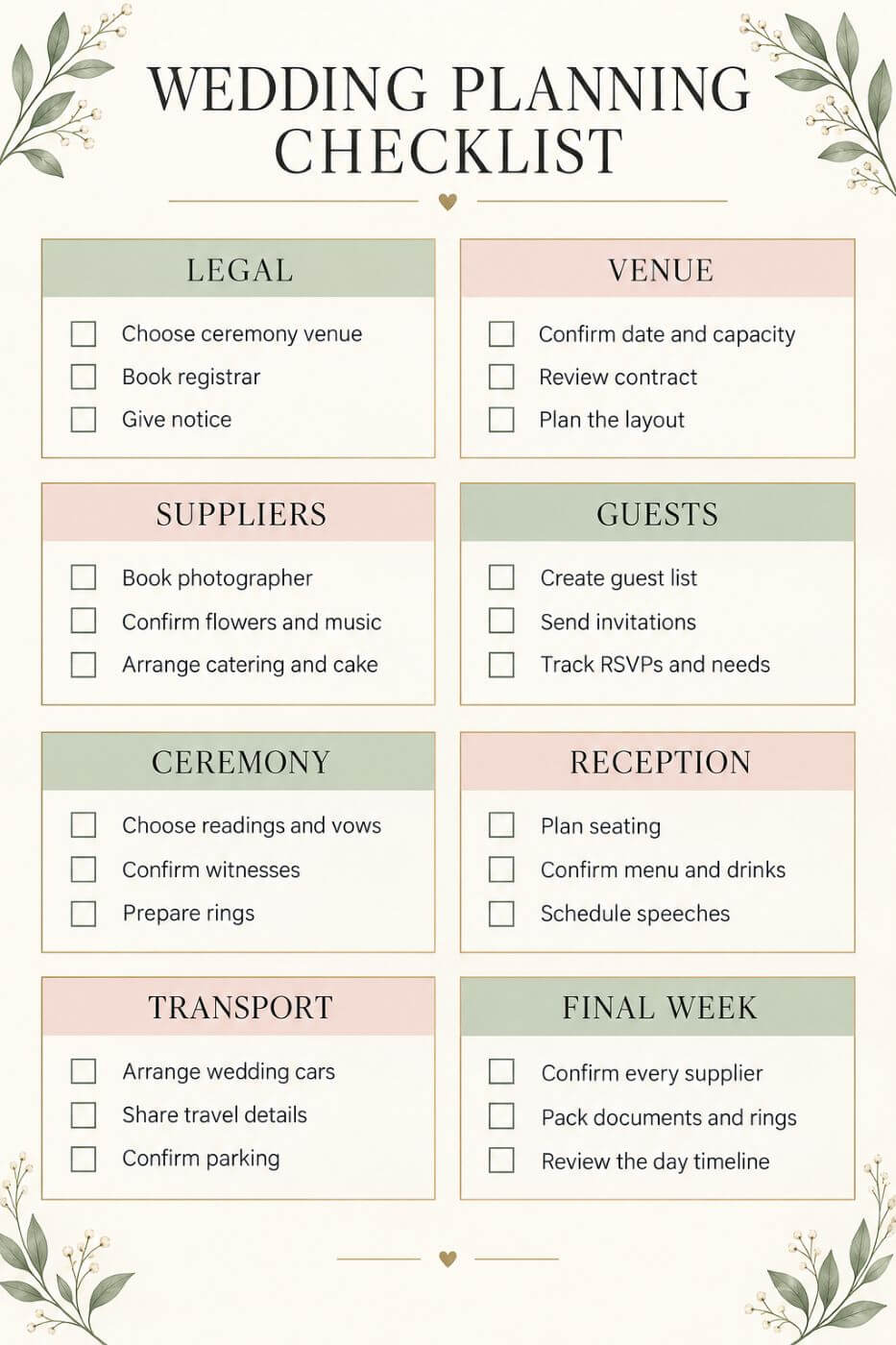
Start with the decisions that affect everything else:
- Decide whether you want a marriage, civil partnership, religious ceremony, civil ceremony, or separate celebrant-led celebration.
- Set your budget.
- Draft your guest list.
- Choose the area where you want to marry.
- Shortlist venues.
- Check whether the venue can host a legally binding ceremony.
- Check registrar or ceremony availability.
- Book the venue and ceremony.
- Give notice at the right register office.
- Book your key suppliers.
- Send save-the-dates or invitations.
- Plan the ceremony, reception and guest logistics.
- Finalise the seating plan, supplier timings and wedding-day timeline.
- Complete final legal, payment, packing and transport checks.
The legal part should come early. In England and Wales, you must decide where your ceremony will take place before giving notice, because your notice must include the final venue details.
Download the Free Wedding Planning Checklist
-
Decide What Kind of Ceremony You Want
Before you view venues, decide what kind of ceremony you are planning. This shapes what you can book, who needs to be present and whether the ceremony itself is legally binding.
The main options are:
| Ceremony type | Legally binding? | Typical setting |
| Civil marriage ceremony | Yes | Register office or approved venue |
| Civil partnership ceremony | Yes | Register office or approved venue |
| Religious marriage ceremony | Yes, if legal requirements are met | Registered religious building |
| Celebrant-led ceremony | Usually no by itself | Almost anywhere with permission |
| Symbolic ceremony after legal ceremony | No additional legal effect | Venue, garden, beach, family home or destination |
For example, a couple in West Sussex might hold a short legal ceremony at a ceremony room in Chichester, Crawley, Horsham or Worthing, then have a larger celebrant-led celebration at a countryside venue. Another couple might choose a licensed hotel or manor house and have the civil ceremony and reception in the same place.
West Sussex County Council explains the distinction clearly: legally binding ceremonies must be performed by, or in the presence of, registrars at a licensed venue or ceremony room, or by an authorised person at a religious building. Ceremonies that are not legally binding are treated as celebratory ceremonies.
-
Understand the Legal Steps in England and Wales
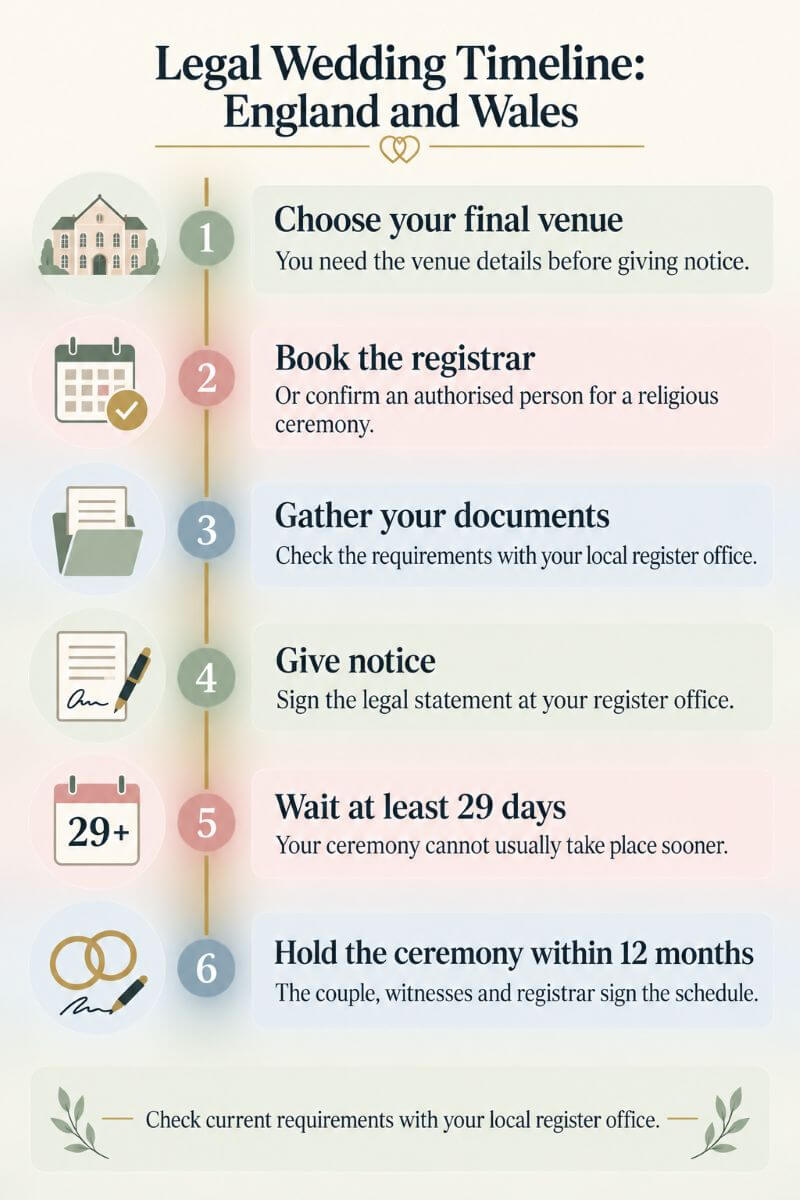
For most civil ceremonies, the legal sequence is:
- Choose the ceremony venue.
- Book the ceremony or registrar.
- Give notice.
- Wait the required notice period.
- Hold the ceremony within the valid notice period.
- Sign the legal schedule or document at the ceremony.
GOV.UK says you must give notice at least 29 days before your ceremony and hold the ceremony within 12 months of giving notice. You usually give notice at your local register office after living in that registration district for the previous seven days.
For a civil ceremony, you can marry or form a civil partnership at a register office or at a venue approved by the local council, such as a hotel or stately home. A registrar must carry out, or be present at, the ceremony, and you must have at least two witnesses.
Civil ceremonies can include readings, songs and music, but they must not include religious content. If you want religious elements, you may need a religious ceremony or a separate blessing after the civil ceremony.
-
Set the Budget Before You Fall in Love With a Venue
Your budget should come before serious venue shopping. A venue may look affordable at first, but the full cost depends on catering, drinks, staff, VAT, service charges, furniture, accommodation, registrar fees, transport, decor and supplier access.
Start with three numbers:
| Budget number | What it means |
| Comfortable target | What you would like to spend |
| Maximum limit | What you can spend without regret |
| Contingency | Money held back for extras, changes or emergencies |
A sensible wedding budget usually includes:
- Ceremony and registrar fees
- Venue hire
- Food and drink
- Photography and videography
- Flowers and decor
- Music and entertainment
- Outfits and alterations
- Hair, makeup and grooming
- Stationery and postage
- Cake or desserts
- Transport
- Accommodation
- Wedding insurance
- Gifts, favours and thank-you items
- Final payments, tips and contingency
The biggest budget lever is usually the guest list. Every additional guest can affect catering, drinks, tables, chairs, stationery, favours, transport and room size.
A useful rule is to choose your top three priorities before spending. For one couple, that might be food, photography and live music. For another, it might be guest comfort, flowers and a relaxed weekend atmosphere. You do not have to spend evenly across every category.
-
Draft the Guest List Early
The guest list affects the venue, budget, catering, transport, accommodation and atmosphere.
Start with three lists:
| List | Who goes on it |
| Essential guests | Immediate family, closest friends, people you cannot imagine marrying without |
| Preferred guests | People you would love to invite if space and budget allow |
| Extended guests | Wider family, colleagues, family friends, optional plus-ones |
Then agree on your rules:
- Are children invited?
- Are plus-ones invited?
- Are work colleagues invited?
- Are evening-only guests part of the plan?
- Are both families working from the same assumptions?
- Are there accessibility, dietary or travel needs you must plan around?
Do this before you book the venue. A 45-person ceremony, a 90-person wedding breakfast and a 150-person evening reception are three different planning problems.
-
Choose the Area and Venue
Once you know the rough budget and guest count, start looking at locations.
Think about the wedding from your guests’ point of view, not just from the photographer’s. A venue needs to work for ceremony legality, travel, parking, access, weather, catering, music, guest flow and the end of the night.
Questions to ask every venue:
- Is the venue approved for civil marriages and civil partnerships?
- Can the legal ceremony and reception happen in the same place?
- What is the maximum capacity for the ceremony, meal and evening reception?
- What is included in the hire fee?
- Is catering in-house or external?
- Are tables, chairs, linen, crockery and glassware included?
- What time can suppliers access the venue?
- What time must music finish?
- Are there noise restrictions?
- Is there a wet-weather plan?
- Are candles, confetti, sparklers or fireworks allowed?
- Is there enough parking?
- Is the venue accessible for disabled guests?
- Are there nearby hotels, taxis or train links?
- What is the cancellation or postponement policy?
Sussex is a useful example. East Sussex promotes coastlines, towns, countryside and more than 85 licensed venues. West Sussex has licensed venues, council ceremony rooms and external venue options, and its booking guidance says couples should choose and provisionally book an external venue before completing the registrar booking form.
The same principle applies across England and Wales: do not assume the venue booking and the registrar booking are the same thing. Confirm both.
-
Book the Registrar or Ceremony Team
If you are having a civil ceremony at a register office or approved venue, you need registrar availability as well as venue availability. Some venues help with this, but you should still check who is responsible for making the booking.
In West Sussex, for example, couples using an external licensed venue must have chosen and provisionally booked the venue before completing the registrar booking form. West Sussex also advises giving notice at least six to eight months before the ceremony, even though the legal minimum notice period is shorter.
Local ceremony services may also have specific timings on the day. East Sussex says that, for licensed venue ceremonies, the registrar meets each person separately before the ceremony: 30 minutes before for the first person and 15 minutes before for the second.
Build this into your wedding-day timeline. Do not schedule the couple to arrive at the ceremony at the last possible minute.
-
Give Notice
Giving notice is the formal legal statement that you intend to marry or form a civil partnership. It is not the same as booking the venue, and it is not optional.
You usually give notice at the register office for the district where you have lived for the previous seven days. If you and your partner live in different registration districts, you usually give notice separately in your own districts. GOV.UK says couples must give notice together in some cases where one partner is from outside the UK or Ireland.
You must bring original documents to your notice appointment. GOV.UK lists documents including final venue details, proof of address, proof of name changes, and either a valid passport or UK birth certificate. If you have been married or in a civil partnership before, you may also need evidence such as a final order, decree absolute or former partner’s death certificate. If either of you is from outside the UK, additional documents may be required, including proof of immigration status and translations of documents not in English.
A simple notice checklist:
- Final ceremony venue details
- Proof of home address
- Valid passport or accepted birth certificate
- Proof of name change, if relevant
- Divorce, annulment, dissolution or death documents, if relevant
- Immigration status documents, if relevant
- Translations of non-English documents, if relevant
- Appointment fee
- Any local documents requested by your register office
Book the notice appointment only after checking your local requirements. Missing documents can delay the ceremony.
-
Decide Whether You Need a Planner or Coordinator
You do not need a wedding planner, but you do need someone responsible for logistics.
There are three common levels of support:
| Type of support | Best for |
| Full wedding planner | Complex weddings, destination-style weekends, dry-hire venues, busy couples |
| Partial planner | Couples who have booked some elements but need expert help finishing the plan |
| Month-of or day coordinator | Couples doing most planning themselves but needing someone to run the day |
A coordinator is especially useful for dry-hire venues, marquees, family land, multi-location days and weddings with many separate suppliers.
On the day, you should not be the person answering supplier calls, checking table layouts, chasing buttonholes, cueing music, finding missing relatives for photos or solving transport problems. Give those jobs to a coordinator, planner, venue manager or trusted helper.
-
Book the Key Suppliers
Once the date, venue and ceremony are secure, book the suppliers who can only do one wedding per day.
Prioritise:
- Photographer
- Videographer
- Caterer, if not provided by the venue
- Florist
- Hair and makeup artist
- Band or DJ
- Celebrant, if having a non-legal ceremony
- Transport
- Cake maker
- Stationer
- Rental or production company
- Planner or coordinator
Before paying deposits, ask each supplier:
- Are you available on our date?
- What exactly is included?
- What is not included?
- What is the deposit?
- When is the final balance due?
- What happens if we postpone?
- What happens if you are ill or unavailable?
- Do you have insurance?
- Do you need a meal?
- Are travel costs included?
- How much setup time do you need?
- When do you need final details?
- What time will you arrive and leave?
For rural venues, check access carefully. A florist, band or furniture supplier may need extra time if the venue has narrow lanes, limited parking, stairs, fields, uneven ground or restricted setup windows.
-
Plan the Guest Experience
Good wedding planning is not just about how the day looks. It is about how the day moves.
Guests need to know:
- Where to go
- When to arrive
- Where to park
- What to wear
- Whether the ceremony is indoors or outdoors
- Whether children are invited
- Whether transport is provided
- Where they can stay
- How to RSVP
- What food will be served
- Who to contact with questions
This is where a wedding website or guest information page helps. It keeps the invitation clean and gives guests one place to find practical details.
Include:
- Date and time
- Venue address and postcode
- Ceremony start time
- Guest arrival time
- Dress code
- Parking details
- Nearest train station
- Local taxi numbers
- Accommodation suggestions
- RSVP form
- Dietary requirement form
- Accessibility information
- Gift list or registry information
- Children and plus-one policy
- Weekend schedule, if relevant
Sussex example: a Brighton city wedding may need advice about parking, hotels and walking between venues. A South Downs or rural West Sussex wedding may need stronger taxi planning, coach transport or clear instructions for guests driving on country lanes. A coastal ceremony may need wind, weather and footwear advice.
-
Plan the Ceremony
The ceremony is the part that legally and emotionally anchors the day.
For a civil ceremony, decide:
- Who enters and in what order
- Whether you will have music
- Who will do readings
- Whether you will write personal vows
- Who will hold the rings
- Who the witnesses will be
- Whether guests can take photos
- Whether you want an unplugged ceremony
- Whether confetti is allowed
- How guests will move from ceremony to reception
For civil ceremonies, remember that religious content is not allowed. East Sussex, for example, says personal additions must be approved by the Ceremonies Hub and religious additions are not permitted. It also says personal vows at licensed venue ceremonies should be solemn, dignified, non-religious and no more than 300 words.
Do not leave readings, vows and music until the final week. These details often take longer than expected because they feel personal.
-
Plan the Reception
Before choosing details, build the flow of the reception.
A typical order might be:
- Ceremony
- Confetti or exit
- Drinks reception
- Group photos
- Couple portraits
- Wedding breakfast
- Speeches
- Room turnaround
- Evening guests arrive
- Cake cutting
- First dance
- Evening food
- Last dance
- Guest transport
You can change the order. Some couples do speeches before the meal so speakers can relax. Some cut the cake earlier so the photographer can capture it. Some skip the first dance. Some have private vows before the ceremony and keep the legal ceremony short.
The best reception timeline avoids long gaps. Guests should not be left wondering where to go, when they will eat or what happens next.
-
Build the Seating Plan
The seating plan is part logistics, part diplomacy.
Think about:
- Family dynamics
- Older guests
- Children
- Wheelchair access
- Guests with hearing or sight needs
- High chairs
- Guests who know few people
- Guests who should not be seated together
- Speaker visibility
- Distance from speakers, band or DJ
- Easy access to toilets and exits
Do not start the final table plan until you have RSVPs. You can draft early, but the real seating plan comes after final numbers.
-
Create the Wedding Planning Timeline
Use this as a flexible guide. If you have less than a year, compress the early tasks and prioritise legal ceremony, venue, guest list, registrar and key suppliers.
12 Months or More Before
- Decide the type of ceremony.
- Set your budget.
- Draft the guest list.
- Choose the area.
- View venues.
- Check ceremony and registrar availability.
- Book the venue.
- Book the registrar, where needed.
- Start researching suppliers.
- Create your planning spreadsheet.
- Consider wedding insurance.
9 to 11 Months Before
- Book photographer and videographer.
- Book caterer, if needed.
- Book florist, entertainment and hair/makeup.
- Create your wedding website.
- Start outfit shopping.
- Reserve accommodation blocks, if useful.
- Send save-the-dates if guests are travelling.
- Choose wedding party members, if having them.
6 to 8 Months Before
- Give notice if your ceremony is booked and your local register office recommends doing it now.
- Plan the ceremony structure.
- Start invitation design.
- Arrange transport.
- Confirm wedding party outfits.
- Plan the honeymoon or minimoon.
- Start decor and stationery decisions.
3 to 5 Months Before
- Send invitations.
- Buy wedding rings.
- Confirm food and drink.
- Choose readings and music.
- Draft the seating plan.
- Book final fittings.
- Confirm evening entertainment.
- Plan speeches.
- Arrange gifts, if giving them.
1 to 2 Months Before
- Chase RSVPs.
- Confirm final guest numbers.
- Send dietary requirements to the caterer.
- Submit ceremony choices forms where required.
- Finalise the seating plan.
- Confirm supplier timings.
- Create the wedding-day timeline.
- Prepare final payments.
- Write vows and speeches.
- Confirm transport.
East Sussex, for example, asks couples having a licensed venue ceremony to submit the ceremony options form at least one month before the ceremony date.
Final Week
- Confirm supplier arrival times.
- Pack ceremony documents.
- Pack rings.
- Print vows and speeches.
- Steam outfits.
- Break in shoes.
- Pack an emergency kit.
- Confirm the weather plan.
- Confirm guest transport.
- Prepare payment or tip envelopes.
- Label decor boxes.
- Assign someone to collect gifts and cards.
- Assign someone to take items home.
- Assign someone to return hired items.
-
Create the Wedding-Day Timeline
The wedding-day timeline should be clear enough that no one needs to ask you what happens next.
Include:
- Venue access time
- Supplier arrival times
- Hair and makeup start time
- Photographer arrival
- Outfit dressing time
- Transport departure
- Registrar interviews
- Ceremony start time
- Ceremony end time
- Confetti or exit
- Drinks reception
- Group photos
- Couple portraits
- Meal call
- Speeches
- Evening guest arrival
- Cake cutting
- First dance
- Evening food
- Last orders
- Last dance
- Guest transport
- Supplier collection or breakdown
Share the final timeline with:
- Venue manager
- Registrar or celebrant
- Planner or coordinator
- Photographer
- Videographer
- Caterer
- Florist
- Band or DJ
- Transport providers
- Wedding party
- Immediate family
Build in buffers. The morning almost always takes longer than expected. Family photos almost always need more time than the couple thinks. Transport can run late. Dresses, suits, shoes, flowers and buttonholes can all create small delays.
A calm timeline is not a rigid timeline. It is a timeline with enough space to absorb real life.
-
Final Wedding Checklist
Use this in the final month.
| Area | Final checks |
| Legal | Notice completed, registrar confirmed, documents checked, witnesses chosen |
| Guests | Final numbers confirmed, dietary needs sent, accessibility needs handled |
| Venue | Timings confirmed, layout confirmed, wet-weather plan confirmed |
| Suppliers | Arrival times confirmed, final balances scheduled, contact list shared |
| Ceremony | Music chosen, readings printed, vows printed, rings packed |
| Reception | Table plan finished, place cards ready, speeches planned |
| Outfits | Alterations complete, outfits steamed, shoes broken in |
| Transport | Couple transport, guest transport and end-of-night plans confirmed |
| Packing | Decor boxes labelled, emergency kit packed, overnight bag ready |
| Aftercare | Gift/card collection assigned, hire returns assigned, certificate process understood |
Keep one master folder, digital or physical, with supplier contacts, contracts, timeline, payment notes, ceremony paperwork and emergency contacts.
-
After the Wedding
A complete wedding plan includes the week after the wedding.
After the day:
- Return hired outfits and decor.
- Collect anything left at the venue.
- Pay any final supplier balances.
- Order extra certificates if needed.
- Send thank-you messages.
- Leave supplier reviews.
- Preserve flowers, outfits or keepsakes if wanted.
- Back up preview photos.
- Begin any name-change admin, if relevant.
GOV.UK says that after the ceremony, the signed schedule is sent to the local register office and added to the register; after that, couples can get their marriage or civil partnership certificate.
Frequently Asked Questions
What is the first thing to do when planning a wedding in England and Wales?
Start by deciding the ceremony type, approximate budget, guest count and preferred area. Then check whether your venue can host a legally binding ceremony and whether a registrar or authorised person is available.
Can we legally marry anywhere in England and Wales?
No. For a civil ceremony, you need a register office or a venue approved by the local council, and a registrar must carry out or be present at the ceremony. For a religious ceremony, the rules depend on the religious building and authorised person.
When should we give notice?
The legal minimum is at least 29 days before the ceremony, and the ceremony must take place within 12 months of giving notice. In practice, many local registration services recommend arranging notice earlier once the venue and ceremony are booked, because appointment availability can affect timing.
Do we give notice where we live or where we are getting married?
You usually give notice at the register office for the district where you have lived for the previous seven days. If you live outside the area where you are marrying, you usually give notice where you live, not where the venue is.
What documents do we need to give notice?
You usually need final venue details, proof of address, proof of name changes if relevant, and a valid passport or UK birth certificate. Additional documents may be needed if you have been married or in a civil partnership before, or if either partner is from outside the UK.
Do we need two witnesses?
Yes. GOV.UK says civil ceremonies require at least two witnesses.
Can we include religious readings in a civil ceremony?
No. Civil ceremonies can include readings, songs and music, but they must not include religious content.
Is a celebrant-led ceremony legally binding?
Usually not by itself. Many couples have a legal ceremony at a register office or approved venue, then hold a celebrant-led ceremony somewhere more personal. Check the legal status of your ceremony before assuming you are married or civil partnered.
Do we need a wedding planner?
Not necessarily. A planner is useful for complex weddings, dry-hire venues, large guest lists and multi-day celebrations. A coordinator is useful for almost any wedding where you do not want to manage suppliers and logistics yourself on the day.
How long does it take to plan a wedding?
A year or more gives you more choice, especially for popular venues and suppliers, but a shorter timeline can work if you are flexible. The non-negotiables are the legal steps, venue availability, registrar availability, guest communication and supplier bookings.
Final Thoughts
The best way to plan a wedding in England and Wales is to get the legal structure right first, then build the celebration around it.
Choose the ceremony type. Confirm whether your venue can host a legally binding ceremony. Check registrar or authorised-person availability. Give notice at the right register office with the right documents. Once that foundation is secure, the rest of the planning becomes easier: budget, guests, suppliers, food, music, decor, transport and the final timeline.
A good wedding does not need every possible extra. It needs clear decisions, honest priorities, good communication and enough space in the day for you to enjoy the people who came to celebrate with you.


